Tag Archives: Atonement

Atonement & Suffering

We witness and experience suffering in our world on a regular basis: devastating weather events, violent crimes, unexpected health complications, and other kinds of trauma. In the overwhelming firehouse that has been the discussion of atonement theology this semester, where is suffering?

Theories of Atonement

Ransom theory, the main theology of atonement for 1000 years, cites Christ’s purpose on earth was to pay a ransom to the Devil to get humanity back. One of the interesting components of this theory is that under it, the devil is just as powerful as God. Christ isn’t just saving us from sin. Christ is saving us from evil. By defeating these powers, Jesus saves humanity from our suffering.

Satisfaction theory focuses on the problem of our sin as something  we cannot reconcile ourselves. God created humanity, so only God could absolve humanity. In the Incarnation, God became human to save us, since sin can only be forgiven by God. There’s no issues of the devil being on par with God. While suffering isn’t explicitly mentioned, if it is associated with sin, then it creates a very problematic answer to the problem of suffering…

Penal substitution, as previously discussed, focuses on the law and Christ bearing the punishment for our sins, suffering in our place. It’s confusing in terms of suffering: if Christ is suffering the punishment for our sins, then what did we do to deserve suffering?

Moral influence theory (my favorite) states that Christ was sent by God because God loves us. It’s big with the warm fuzzies and does not have the problem of violence that the other two theories are often criticized for:

“Indeed how cruel and wicked it seems that anyone should demand the blood of an innocent person as the price for anything, or that it should in any way please him that an innocent man should be slain – still less that God should consider the death of this Son so agreeable that be it he should be reconciled to the whole world?”[1]

This theory of atonement leaves more room for the human heart, but raises the question: if all you need is love, where is there room for suffering? Is all suffering evil?

For those of who who’ve seen the wonder that is Inside Out, we know that happy rainbows and butterflies and glitter cannot fix everything, and for those of us who’ve done CPE (Clinical Pastoral Education), we recognize Sadness’s amazing counseling of Bing Bong, as she helps him process his grief and name his feelings. Even Joy eventually recognizes the importance of sadness! Our visible signs of suffering, even from the smallest indications of strain, cue others that we need help, support, and comfort.

How do we handle suffering on a societal level?

While cultures of over commitment and putting on a brave face generally seem to handle suffering by avoidance (not the CPE recommended approach), when I try to think of an example of acknowledging suffering well, one stands out about all the rest: South Africa’s Truth and Reconciliation Commission

137688-004-EC2CD3EB

There are some brilliant documentaries on this that know far more than I do; I know enough to know just how much I have left to learn!

Here, after the fall of apartheid, South Africans from all walks of life were invited to tell their stories[1]: the crimes they witnessed, and the injustice and violence they or their loved ones experienced. Even more, white South Africans who had served in police forces could be granted amnesty in exchange for their truths too, in hopes of helping people who left wondering about what had happened to their loved ones to get the answers they needed to properly grieve. The numbers are staggering:

  • Over 6,750 statements were received from witnesses
  • 1,355 hours of recordings were collected
  • 7 national events held[2]

Just stop for a second and think about what an amazing undertaking it is to support people in truth-telling about such a deep wound on a national scale. Perhaps places where small-scale reconciliation didn’t quite go as planned should take a page from South Africa’s book. There are plenty of pages to choose from; the final report from the Truth and Reconciliation Commission is six volumes!

How do we translate this success to a personal level?’

In an earlier post, I mentioned that my group and I had the privilege of dining with Fr Michael Lapsley during our pilgrimage to South Africa in January. Born in New Zealand in 1948, Michael Lapsley went to Australia as a teenager to study to be a priest, and in 1973, he went to South Africa to serve as a chaplain for the Anglican Student Federation in Durban, where he was required to be a priest to black, white, and coloured students. His activity in the anti-apartheid movement led to his being exiled from South Africa in 1976. Lapsley continued his anti-apartheid work in Lesotho for several years, but when it became unsafe to remain there, he relocated to Zimbabwe in 1982. In 1990, his life changed when he received a mail bomb packaged as a religious magazine, triggered by his opening the cover. This act of terror inflicted serious injuries on Lapsley, who lost both his hands and sight in one of his eyes in the blast. By 1993, he had recovered sufficiently to serve as the Chaplain of the Trauma Center for Victims of Violence and Torture in Cape Town during the Truth and Reconciliation Process.

Fr. Lapsley’s journey up to this point inspired him to found the Institute for the Healing of Memories, which focuses on creating a safe space for people to tell their story and work through their grief in a parallel process that builds on the work of the Truth and Reconciliation Commission. He believes that his own success in working through his experience is a result of his story being acknowledged, reverence, recognized, and given a moral context, so he seeks to create a space that provides these four pillars for others as they process their trauma. A nation needs to focus on the political, social and economic for its well-being and people needs to focus on the physical, emotional, and spiritual for theirs.

Fr. Michael Lapsley spends 3-4 months per year in the United States doing Healing of Memories workshops.

The space between the suffering of the crucifixion and the joyous, redemptive miracle of the resurrection is the tension we must navigate as we lead and as we serve.


[1] You know how I feel about storytelling

[2] Truth and Reconciliation Commission: By the numbers

[1] Reid, Patrick V. Readings in Western Religious Thought. 2 vols. New York: Paulist Press, ©1987-1995, 195.

Penal Substitution, the Convict Christ, & Rising Again

Our discussions of atonement this semester have centered around the four major atonement theories: ransom, satisfaction, moral influence, and penal substitution.

Some Basics of Penal Substitution

Penal substitution centers around the idea that Christ died on the cross as a substitute for our sins. God transferred the guilt of our sins to Christ, and Christ bore the punishment that we deserved, in the crucifixion. Penal substitution sees the entire human race as criminals, relying on Christ to be innocent and cleansed from sin.

Under penal substitution, Christ’s purpose was to bring order. This theory is a product of the Reformation. Penal substitution is a response to a culture that focused and the law and a need for order in a time of political and social upheaval. Anselm’s Satisfaction theory seemed like too much of a commercial transaction.

Some key theologians in discussions of penal substitution include Martin Luther, John Calvin, Faustus Socinus[1], and Hugo Grotius. Luther wrote:

“He sent his Son in to the world, heaped up all the sins of all upon him and said to him …You be the person of all people, the one who has committed the sins of all people…Now the law comes along and says I find that sinner taking on himself the sin of all people; I see no other sins but those in him. So let him die on the cross! And so it attacks him and kills him. This done, the whole world is purged of all sin.” [2]

It’s very “an eye for an eye.”[3] A crime was committed. The law looks for someone to carry the punishment, and since all of that sin was transferred to Christ, Christ dies for our sins. In case that legalism isn’t depressing enough, John Calvin’s penal substitution musings recall that Christ had to die for our sins so that we might escape “God’s dreadful judgement.”[4] Ouch. I experience God as merciful, gracious, and patient; and I preach, teach, and live accordingly. “Dreadful judgement” sounds like something that happens in a bad religious horror movie or how people justify loving their neighbors in a way that has rules and conditions… Anyway…

Arguments Against Penal Substitution

Faustus Socinus (1539-1604) wrote a book questioning many theories atonement but focused most pointedly on penal substitution. He didn’t understand why God couldn’t simply forgive sins and why God would insist on punishing the guilty party: “There is no creditor who, according to the strict letter of the law, is not able to forgive his debtors part of the debt or the whole debt, having received no satisfaction.”[5] Socinus saw substitution as unjust. He further supported this argument by citing scripture passages: “Acquitting the guilty and condemning the innocent – the Lord detests them both.”[6]

Jens Soering’s The Convict Christ

Jen Soering’s book talks about Jesus’ dying as convicted felon, driving the point home with phrases such as “capital punishment” and “common criminal.” Soering doesn’t let the reader comfortably separate Christ dying on the cross for our sins and sin that is the brokenness of our criminal justice system. When God decided to make Godself vulnerable in human flesh, he did so as a death row inmate. The author is Christ-like himself in his counter-cultural challenge to acknowledge our sins and where we might be disowning Christ by not loving him in “the least” of our own as we’re called to in Matthew 25:36-40.[7]

“To see Christ’s self-sacrificial death as the ultimate expression of love is comfortable and familiar – though not especially challenging, since none of us really expect to have to give our own lives for our brothers [and sisters]. But to see Jesus’ execution as the sum and substance of evil is strange and unsettling, since it calls into question our own criminal justice system. For how can we justify using police and court procedures today that are virtually identical to those used to prosecute Christ two thousand years ago?”[8]

Here are some depressing facts[9] to drive Soering’s point home:

  • The U.S. imprisons a larger percentage of its black population than South Africa did at the height of apartheid.
  • The United States has 5% of the world’s population, but 25% of the world’s prisoners.
  • The total incarcerated population in the U.S. is a staggering 2.4 million — a 500% increase over the past 30 years.
  • At the end of 2007, 1 in 31 adults was behind bars, on probation or on parole.
  • Parole violators accounted for more than 35% of all prison admissions in 2000. Of those, only one-third were returned for a new conviction; the rest were returned for a technical violation, such as missing a meeting with the parole officer.
  • A first-time drug offense carries a sentence of 5-10 years. In other developed countries, that sentence would be six months of jail time, if any at all.
    • African-Americans comprised 12% of regular drug users, but almost 40% of those arrested for drug offenses.
  • Conservative estimates put innocent people who plead guilty between 2% and 5%, which translates to tens of thousands of innocent people behind bars today.

‘Cause let’s be real here. The Church has this terrible history of blaming Jews for the crucifixion. That’s the real “dreadful judgement:” our own hypocrisy.

fake

One of my most embarrassing moments in South Africa involved coming home from work on May 2, 2011 and having to assure my housemates that not every American was standing in the streets cheering over the death of another human being, even one who had committed such unfathomable atrocities.

It’s quite a counter-cultural charge we’ve got here: preaching the gospel against the law, only to be convicted and punished to save the community you’re fighting for.

Who would dare spend their whole life preaching the gospel against the law, only to be convicted and punished to save others?

Wait a second… Didn’t I just hear about that somewhere? Maybe some traveling I did recently?

what-did-nelson-mandela-fight-for_4e148e13-f2dc-4fca-b2c4-92cecb6577aa“Never, never and never again shall it be that this beautiful land will again experience the oppression of one by another.” – Nelson Mandela (1918-2013)
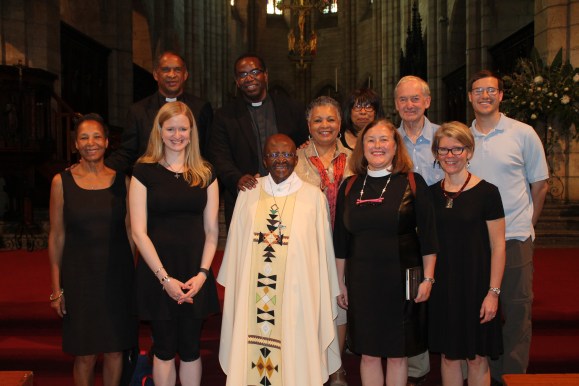
In my adventures on the other side of the world (specifically: South Africa), I received stories of the fight for justice. The men and women of the anti-apartheid movement risked their lives in the dangerous fight for equality, humanity, and dignity for their brothers and sisters and children. Fr. Michael Lapsley brilliantly summed up the necessity of the anti-apartheid movement, when we met him, saying “Apartheid was a way of death carried out in contrary to the Gospel of Life.”[10]

Nelson Mandela is a particularly powerful example of someone who lived his whole life preaching the gospel against the law, only to be convicted like a criminal. Just like Jesus!

Each in their own way, they both rose again.


[1] Seriously? How cool of a name is “Faustus Socinus”!?! Maybe I just like it because it sounds like the kind of name a character on The Ghost of Faffner Hall would’ve had…

[2] Table Talk

[3] Exodus 21:24

[4] John Calvin’s Institutes 2:16:5

[5] Atonement YouTube Dictionary of Theology 1

[6] Proverbs 17:1

[7] “I was naked and you gave me clothing, I was sick and you took care of me, I was in prison and you visited me.’ Then the righteous will answer him, ‘Lord, when was it that we saw you hungry and gave you food, or thirsty and gave you something to drink? And when was it that we saw you a stranger and welcomed you, or naked and gave you clothing? And when was it that we saw you sick or in prison and visited you?’ And the king will answer them, ‘Truly I tell you, just as you did it to one of the least of these who are members of my family, you did it to me.’”

[8] Jens Söring, The Convict Christ: What the Gospel Says About Criminal Justice (Maryknoll, N.Y.: Orbis Books, ©2006), 3.

[9] The hard truth: “19 Actual Statistics About America’s Prison System

[10] January 11, 2016

Introduction: Storytelling, Atonement, South Africa, and Re-learning to Love the Blog

Why am I doing this?

When I was a little girl, I used to write stories for fun. I had this video game with a cartoon bookworm named Wiggins, who lived in a tree, and I would write stories to fill the branches. As my stories and I grew, the tree grew. If I close my eyes, I can still hear the jingle that played at the beginning of the game. It’s so obscure that I cannot find it on YouTube!

Back then, I knew far more about the worlds I was imagining than about the one I was living in. All the Star Trek: The Next Generation I watched (for as long as I can remember) instilled in me a sense of endless possibility, continual crossing of horizon lines, and humanity being capable of bettering itself.  I think believing the best in a people is a good quality to have for a soon-to-be Episcopal priest.

Now that I’ve been existing on this planet for a while (on my good days, “existing” can even be considered “adulting”), I have more stories in my heart than just the ones I imagine, both ones I’ve lived and ones that have been entrusted to me along the way. When my professor, the Rev. Dr. Michael Battle, asked me to articulate my greatest passion, I told him that it is storytelling. The priest I grew up with, The Rev. Dr. Ken Gorman, preached a powerful last sermon in which he talked about how we all have a piece of the Divine within us. Furthermore, when we make ourselves vulnerable, we not only reveal that bit of Christ in ourselves, but we invite others to do the same. Telling out stories – our deep truths and our journeys – and receiving the stories of others is how we encounter Christ in each other. It’s how we build bridges across the gaps between us. It’s where we laid our own chief cornerstone in the stories of Abraham, Moses, Esther, Paul, and Jesus.

Currently, I’m in my last semester at General Seminary, and as I get ready to graduate, I’m taking two classes that include a social media project, storytelling and reflecting on both the theology of atonement, which I’m taking a course in, and a pilgrimage course to South Africa.

In January, I went to South Africa with a group of students, alumni, and a board member led by the Rev. Dr. Michael Battle and his South African colleague, the Rev. Edwin Arrison.  Our week-long journey, entitled “A Walk with Desmond Tutu,” involved lots of traveling and lots of listening. We broke bread with powerful voices in the Anglican Church today and the anti-apartheid movement from years ago, including Fr. Michael Lapsley; the Rev. Rene August; John Allen, Desmond Tutu’s biographer; Professor John de Gruchy; the Very Rev. Michael Weeder, Dean of St. George’s Cathedral; Nomfundo Walaza; students in the #feesmustfall movement and more. We visited Robben Island; the District Six Museum; Volmoed, a retreat center near Hermanus; Zwelihle, a township in Hermanus; a farm in Stellenbosch; the University of the Western Cape; Stellenbosch University; and St. George’s Cathedral. Our journey culminated in having breakfast with Archbishop Tutu himself. It was an amazing adventure! Exiting the “bubble” of the United States offers the chance to gain perspective, both on how our culture looks from afar and how my own life looks, when I step back from it. If you’ve ever seen Monet’s water lilies, then you know that if you stand too close, it can look like nothing more than big blobs of paint. It’s when you step away and take some space that you see that that “blob” is a flower, and it’s surrounded by other flowers, with a whole lot more going on than you can see up close.

IMG_4419“A Walk with Desmond Tutu” – January 2016
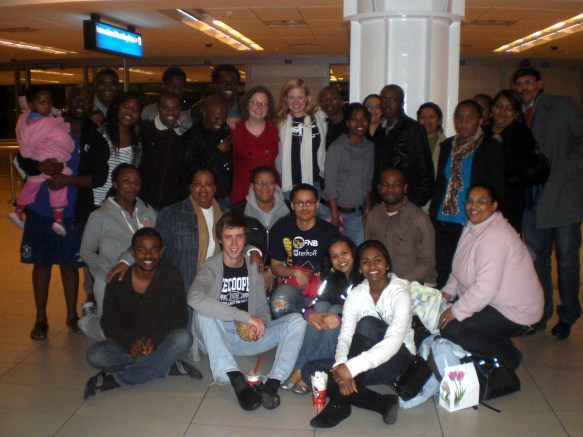
This adventure to South Africa was not my first one, but my first trip is the one that taught me I needed to go back. My second trip taught me going back once is not enough. For my first trip, I was a Young Adult Service Corps missionary, sent by the Episcopal Church. My stories surrounded three pillars. First, I lived at the Anglican Society House (“AnHouse”) at the University of Cape Town and journeyed with my thirteen housemates in daily life and adventures. Second, I commuted (by train and public taxi) to Cape Town proper a couple of times a week to work in the main office for the Anglican Student Federation (ASF), the student network for the Anglican Church of Southern Africa. Here, I got to know the amazing student leaders who make God’s work extend across the province with very little resources. Finally, while I didn’t explicitly work at Hope Africa (Amanda Akes did), the staff there were my people, too. ❤

CIMG5946levels***Highlights of the Good Life***
August 2010- August 2011

With this foundation, I hope to talk about what I’m starting to learn about atonement as well as unpack some of my reflections from my adventures in South Africa.